Flotation
Dissolved Air Flotation (DAF) is an advanced water purification method based on the principle of accelerated floating of contaminant particles. By introducing microscopic air bubbles into the wastewater, they adhere to the impurities and bring them to the surface. The critical pressurised water that makes this process possible is continuously produced by saturating a portion of the purified water with air under high pressure. The contaminants form a floating sludge layer that is easily scraped off for further processing while the purified water is discharged. DAF is particularly effective in removing suspended solids, fats, and oils, achieving very high efficiencies. However, complete removal of soluble nutrients such as nitrogen and phosphorus often requires additional chemical processes. Details on the precise operation, removal rates, and chemical optimization for phosphorus removal can be found in the sections below.


General Principle
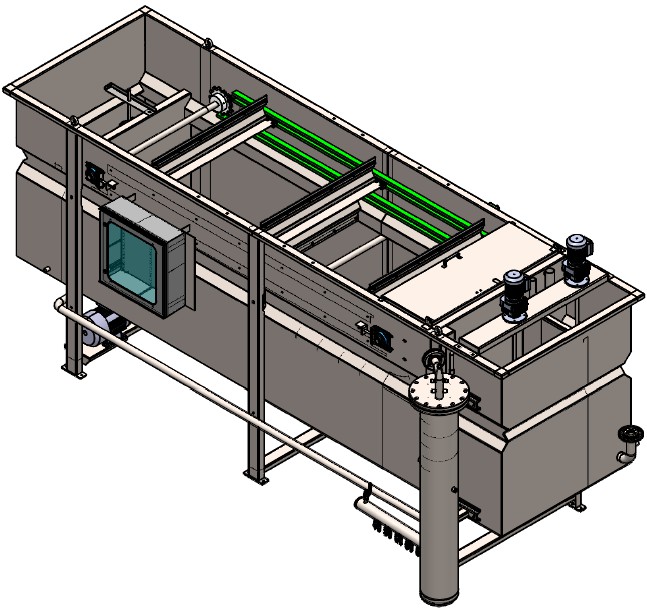
The "Dissolved Air Flotation" system is based on the principle of accelerated floating of suspended particles by introducing tiny air bubbles that adhere to these particles. A distribution system distributes the wastewater across the entire width of the system, and the pressurised water is also injected at this inlet.
The pressurised water, so essential for effective flotation, is continuously produced by recirculating a portion of the purified water (approximately 30%). A centrifugal pump sends this partial flow back to a pressure vessel, ensuring optimal pressure for dissolving air in the water. Controlled compressed air is also added to this pressure vessel to produce optimally air-saturated water. From this pressure vessel, this air-saturated water is returned to the flotation unit. Due to the pressure drop (or relaxation) of this water (from 5-6 bar to 1 atm), the air is released again in the form of tiny air bubbles (30-50 μm, so-called "sparkling water" or "milk water").
These air bubbles adhere to the dirt particles, bringing them to the surface where they form a sludge layer. This layer is removed by the scrapers and collected in the sludge compartment. From this sludge compartment, the excess sludge is then pumped to a sludge buffer. This sludge is further dewatered in a centrifuge or a screw press, or can be collected by a certified collector.
Heavier particles such as sand will not float but will settle. At the bottom of the cone of the system are bottom or purge valves. These valves are pneumatically operated and open at regular intervals. The water pressure in the flotation unit pushes the settled sludge out into the sludge compartment and pumps it to the sludge tank.
The clarified water from the flotation unit flows through the effluent compartment to a further storage tank or, if necessary, to the discharge point.

Phosphate Removal
During coagulation with ferric chloride (FeCl₃), orthophosphate (PO₄³⁻) is removed by forming insoluble iron phosphate precipitates. The exact chemical reaction depends on the pH of the water and the concentrations of the ions involved, but a simplified representation might look like this:
Fe³⁺ + PO₄³⁻ → FePO₄ (s)
In this process, the iron ion (Fe³⁺) reacts with the phosphate ion (PO₄³⁻) to form solid iron phosphate (FePO₄), which decants as a precipitate and is subsequently captured in the flocs formed during flocculation.
During flocculation, the polymer plays a key role in expanding and stabilizing the flocs formed. The polymer adsorbs to the surface of iron phosphate precipitates and other particles, causing them to clump together into larger flocs. These flocs are heavier and settle or rise to the surface more quickly, depending on the density of the flocs relative to water.
The precise mechanisms of flocculation are complex and depend on the type of polymer used. It is generally assumed that polymers contain functional groups that can bond to the particle surfaces, forming a kind of "bridge" between the particles.
The following factors influence orthophosphate removal:
- pH: The pH of the water significantly affects the solubility of iron phosphate. At a certain pH, solubility is minimal and phosphate removal is most efficient.
- Iron chloride dosage: Too low a dosage leads to insufficient phosphate precipitation, while too high a dosage can lead to excessive sludge formation.
- Polymer type: The choice of polymer is important for the effectiveness of flocculation.
- Mixing time: Sufficient mixing time is necessary for optimal coagulation and flocculation processes.
The removal of orthophosphate during coagulation and flocculation is a complex process involving various chemical and physical processes. The formation of insoluble iron phosphate precipitates and subsequent flocculation with polymers can remove significant amounts of phosphorus from wastewater.


What is removed by a DAF and what isn't?
While DAF is an excellent method for removing suspended solids, grease, and oil, it is not always sufficient for the complete removal of nitrogen and phosphorus. The effectiveness of DAF for removing these nutrients depends on several factors and the specific composition of the wastewater. Complete removal of nitrogen and phosphorus often requires additional processes, such as biological nitrification and denitrification for nitrogen and biological phosphorus removal.
Removal Rates
- For suspended solids, removal rates of 90% and higher can be achieved with DAF. This makes it a highly efficient technique for pre-treating wastewater before it goes to biological treatment.
- COD: DAF can remove significant amounts of COD, especially when dealing with grease, oil, and suspended solids. Removal rates of 50% to 80% are achievable, but can be higher depending on the specific situation.
- TN: For total nitrogen, removal rates with DAF are generally lower than for COD. Soluble nitrogen compounds such as nitrate and nitrite are removed less effectively. Removal rates of 10% to 30% are realistic, but can be higher for organically bound nitrogen.
- TP: DAF can remove some of the total phosphorus, especially when the phosphorus is bound to solid particles. Removal rates of 20% to 50% are possible, but depend on the form in which the phosphorus is present.
Flotation can also remove other components, but we are happy to discuss this on a case-by-case basis. Feel free to contact us about this!